Internet in Italy — Scheda Tecnica
The original technical fact sheet on Italy's first Internet connection, 1980–1986.
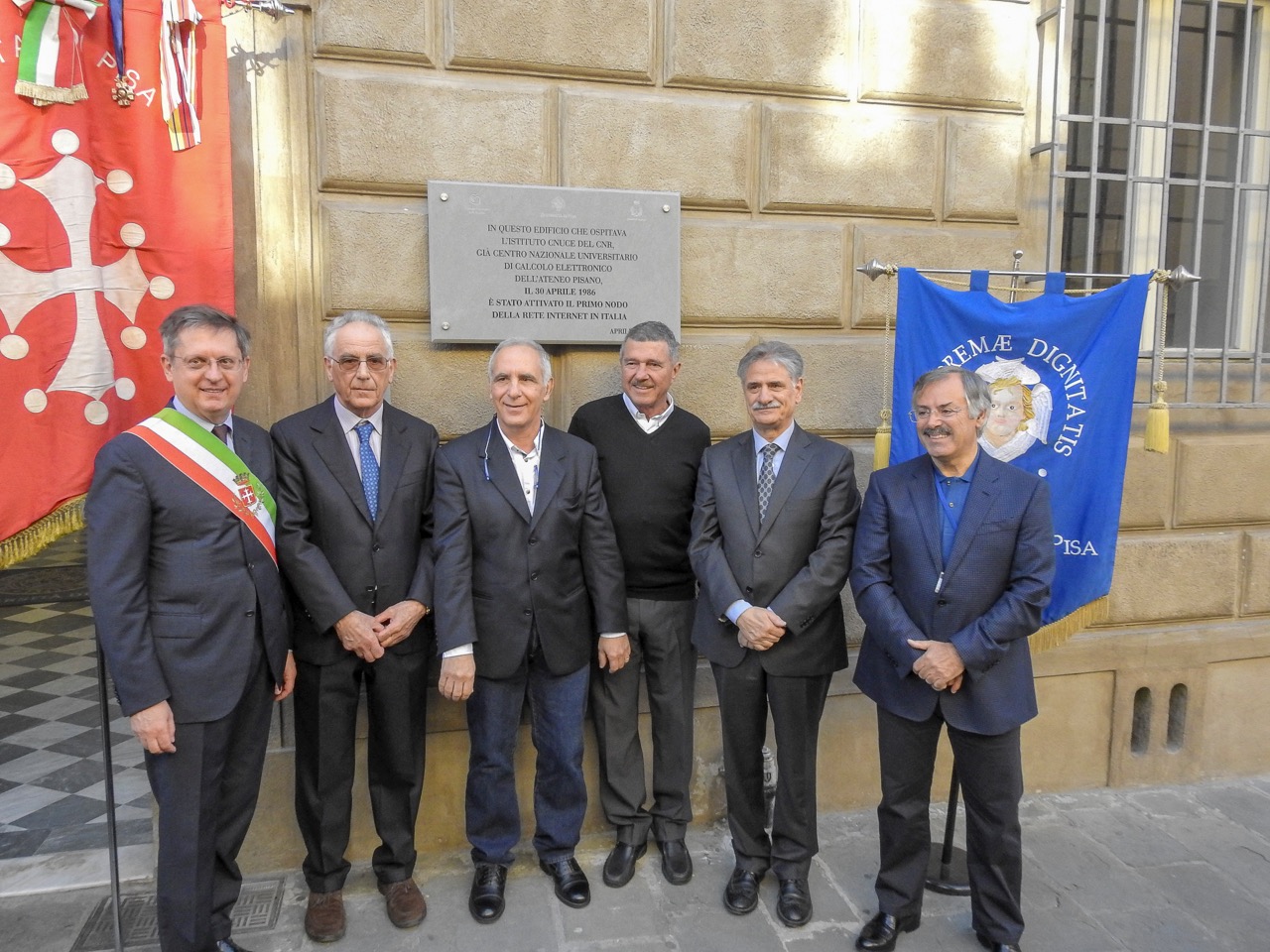
↓ Download PDFThe commemorative plaque marking the site of Italy's first Internet connection, unveiled at the former CNUCE building.
The Day Italy Became Part of the Internet (1980–1986)
Luciano Lenzini tells the story
On 30 April 1986, Italy became part of the Internet.
The connection was established through a gateway installed at CNUCE in Pisa, just a few steps from the Leaning Tower. Today, the event is recognized as a milestone in the history of Italian information technology. At the time, however, it appeared to be simply another research achievement within a rapidly evolving field known as computer networking.
In reality, that historic moment was the culmination of a journey that had begun six years earlier and had required vision, perseverance, and a remarkable amount of patience.
DARPA Extends Internet Experimentation to Europe
At the end of the 1970s, DARPA (Defense Advanced Research Projects Agency) decided to extend the experimental deployment of TCP/IP beyond the United States, involving a small number of European research institutions with significant experience in networking.
At that time, the Internet already interconnected numerous American universities, research centers, and military facilities. Meanwhile, at CNUCE, we had gained international visibility through projects such as RPCNET and STELLA, which had established Pisa as one of Europe's leading centers for networking research.
In 1979, two colleagues, Mario Gerla of UCLA and Luigi Fratta of the Politecnico di Milano, who was then a visiting scholar at UCLA, informed me that DARPA was planning to extend the experimental deployment of TCP/IP to Europe.
Later that year, during a meeting at University College London (UCL), Professor Peter Kirstein showed me the second European Internet node and provided two pieces of information that would prove decisive. First, DARPA had decided to extend Internet technology to Europe. Second, it was actively seeking institutions with significant expertise in computer networking to participate in the experiment.
Peter strongly encouraged me to consider the possibility of connecting Italy to the Internet through CNUCE.
For us, networking was not simply a new communication technology. It was a way to share computing resources, connect research communities, and improve access to scientific computing facilities distributed throughout the country. Convinced of its potential, I sought authorization from the leadership of the National Research Council (CNR) to participate in the experiment.
Joining the Internet Experiment
After obtaining support from Prof. Gianfranco Capriz, Director of CNUCE, and Prof. Giuseppe Biorci, Chairman of the CNR Committee for Scientific Computing, I wrote to Bob Kahn on 12 February 1980 requesting that CNUCE be included among the European Internet experimenters.
His answer arrived almost immediately—and it was positive.
CNUCE became one of the pioneering European participants in the Internet project, together with the University College of London (UCL), the Norwegian Defense Research Establishment (NDRE), and the Germany’s national research center for aeronautics, space, energy, transport, and defense (DFVLR). At that moment, Italy was among the very first countries preparing to join the emerging Internet community.
Building the Italian Internet Node

Turning that vision into reality proved far more difficult than expected.
One of the first steps was to secure institutional support. To help explain the strategic importance of the project, I organized a meeting between Bob Kahn and the members of the CNR Committee for Scientific Computing. The meeting proved successful and resulted in funding of 510 million lire—a substantial investment for the period.
During a subsequent visit to Pisa in the autumn of 1980, Bob Kahn and I designed the architecture of the future Italian Internet node.
The plan relied on SATNET, the satellite network that DARPA used to extend Internet experimentation to Europe. In Italy, access to SATNET would be provided through the large Telespazio ground station at Fucino, equipped with a 35-meter antenna communicating with the Intelsat IV geostationary satellite over the Atlantic Ocean.
The configuration included a gateway installed at CNUCE and connected to the Fucino station through a 48 Kbit/s line—a very high transmission rate at the time. Together, these components would allow Italian researchers to communicate directly with Internet sites in Europe and the United States. The RFC 834 document published in 1982 confirms that the Fucino station already possessed IP addresses at that time.
Six Years of Delays
The technical solution was only part of the challenge.
The project also required the cooperation of the Italian Ministry of Defence, SIP, Italcable, and Telespazio. The problem was not technological but strategic: convincing multiple organizations that Internet connectivity represented an important opportunity for Italy.
Reaching an agreement took nearly three years. The experimental contract was finally signed on 22 August 1984. By then, the project had already accumulated significant delays.
Further delays followed. Procurement procedures moved slowly, and authorization for purchasing the necessary equipment required almost another year.
Then came an unexpected setback.
DARPA informed us that all SATNET installations would need to adopt a new gateway architecture based on the BBN Butterfly computer, a massively parallel system consisting of up to 256 interconnected processors. The new requirement implied higher costs and threatened to restart the entire bureaucratic process from the beginning.
The Butterfly Episode
For the first time, I seriously considered abandoning the project.
After six years of effort, I felt that another round of funding requests and administrative procedures might delay the connection indefinitely.
I decided to communicate my decision personally during a meeting of the International Cooperation Board (ICB) in Washington, the organization responsible for coordinating Internet activities in Europe.
When my turn came to speak, I explained that the adoption of the Butterfly gateway would further postpone the project and that I no longer felt able to continue.
The room fell silent.
Bob Kahn then announced a coffee break. During the break, I noticed him speaking privately with Vint Cerf.
When the meeting resumed, Bob addressed me directly: "Luciano, we want CNUCE to be part of this project. DARPA will fund the Butterfly gateway for you."
At that moment, I knew that the project would continue. Internet would come to Italy after all.
30 April 1986
While institutional and architectural/protocol issues were being resolved, Antonio Blasco Bonito and Marco Sommani worked on the technical implementation of the project. Blasco Bonito was primarily responsible for managing the Butterfly gateway software, while Marco Sommani focused on adapting the TCP/IP software developed by the American researchers to the CNUCE computing environment. Numerous technical problems had to be solved before a stable implementation was achieved.
The connection was anything but plug-and-play.
Finally, on 30 April 1986, Italy established its first Internet connection.
The country became the fourth European nation—after Norway, the United Kingdom, and Germany—to join the Internet.
The Forgotten Achievement
Surprisingly, the event attracted almost no attention.
A letter informing the President of the CNR of the successful connection received no response. Attempts to interest the national press also failed. Few people, even within the scientific community, understood the significance of what had happened.
One of the earliest public demonstrations of the new technology took place on 3 December 1987 at the Enriques High School in Livorno, where students witnessed electronic mail exchanges with Stanford University and the University of Wisconsin. The almost immediate replies generated excitement and enthusiastic applause. For many students, it was their first experience of communicating directly with the wider world through a computer network.
After that, the achievement was largely forgotten for almost three decades.
Historical Significance
On 30 April 1986, Italy became part of the Internet.
At the time, few people understood the significance of the event. The Internet was still a research network used primarily by scientists and engineers. Its future remained uncertain, and competing networking architectures such as OSI appeared equally plausible candidates for global adoption.
Yet the connection established at CNUCE marked the beginning of a profound transformation.
It represented the culmination of more than a decade of networking research in Pisa, from RPCNET and STELLA to OSIRIDE and the TCP/IP experiments promoted by DARPA. It also demonstrated the importance of scientific vision and persistence in overcoming institutional inertia and technological uncertainty.
The impact of that connection extended far beyond the scientific community. Within a few years, Internet technologies would reshape communication, education, commerce, culture, and society on a global scale.
Today, the gateway installed at CNUCE is remembered as the point through which Italy entered the Internet era. What seemed at the time to be a modest research achievement became one of the most significant milestones in the history of Italian information technology.