LABORATORIES AND EXPERIMENTAL ACTIVITIES
The Mechanics of Materials Lab of the DCMN has a long time experience in standard and special material testing, as documented by a large number of scientific and technical papers. Its test facilities allow the mechanical characterisation of many types of materials, including metals, ceramics and composites.
Moreover, the integration with numerical (FEM) analysis tools and advanced experimental mechanics tools, allows to cover, with very efficiency and accuracy, all the phases of test activities, from test planning and design, to interpretation. These capabilities give the DCMN Mechanics of Material Lab a particular capability in managing and conducting very complex test activities, specifically designed for special purposes.
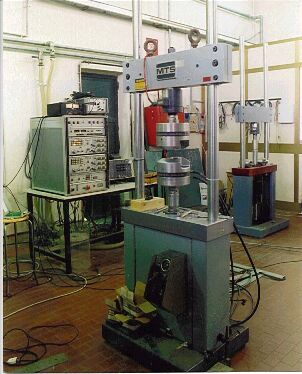
Standard test facilities These include a few electro-hydraulic test frames, having a capacity up to 100 KN. Tests are fully controlled by a Computer Aided Testing (CAT) system, based on several PCs equipped with A/D devices and on specifically developed software. The tests are conducted with fully qualified personnel and procedures, ensuring the reduction of result uncertainties to minimal possible levels. The standard tests that can be conducted include:
|
|
![]() |
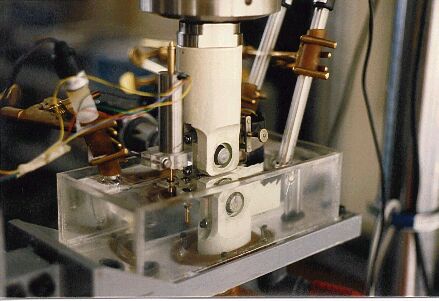
Metallic Materials In addition to standard tests, specific experience and facilities for a few special tests on metallic materials is available, including:
|
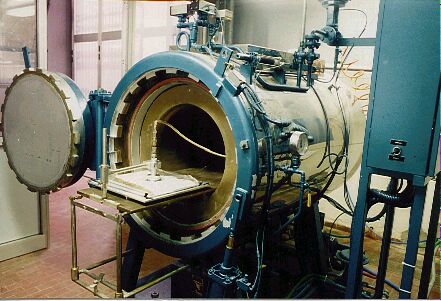
Composite Materials The investigation of composite material properties takes great advantage by the availability of a laminate fabrication laboratory, including a clean room for cutting and lay-up activities and an autoclave for curing laminated components up to about 400 mm x 400 mm x 1000 mm dimension. The DCMN laboratory has experience in manufacturing components with the vacuum bag technique and in special gripping devices required by composite material testing. In addition to standard tensile and fatigue tests, a few special tests can be conducted, including:
|
|
|
Ceramic Coatings
The mechanical characterisation of ceramic coatings is a quite complex task, due to the usually very small thickness of the coating itself. As a consequence, the DCMN test procedures were defined based on a detailed error analysis, which allowed to select the most suitable test configuration and technique and, even more important, to estimate the uncertainty interval associated to each experimental result. Currently available tests on ceramic coatings include:
|
Main Current Research Activities
Fracture mechanics analysis of large diameter welded pipes for gas transportation (sponsored by ILVA) |
|
Evolution of Damage in composite materials |
|
Mechanical characterisation of anti-permeation barrier coatings for fusion reactor application (sponsored by ENEA) |
|
Development of new thermal barrier coatings for gas turbine application (in co-operation with Nuovo Pignone (Firenze), Flame Spray (Milano), University of Bari sponsored by CNR within PFMSTA II) |
|
Fatigue analysis of drill collar threaded joints for oil-drilling application (including full scale fatigue tests on large size components, sponsored by AGIP) |
|
Hydrogen Embrittlement characterisation of steels for fusion reactor application (sponsored by ENEA) |
|
Hydrogen Embrittlement characterisation of steels for chemical reactor application (sponsored by Nuovo Pignone (Massa)) |
THEORETICAL ACTIVITIES
Weight Functions (WF)
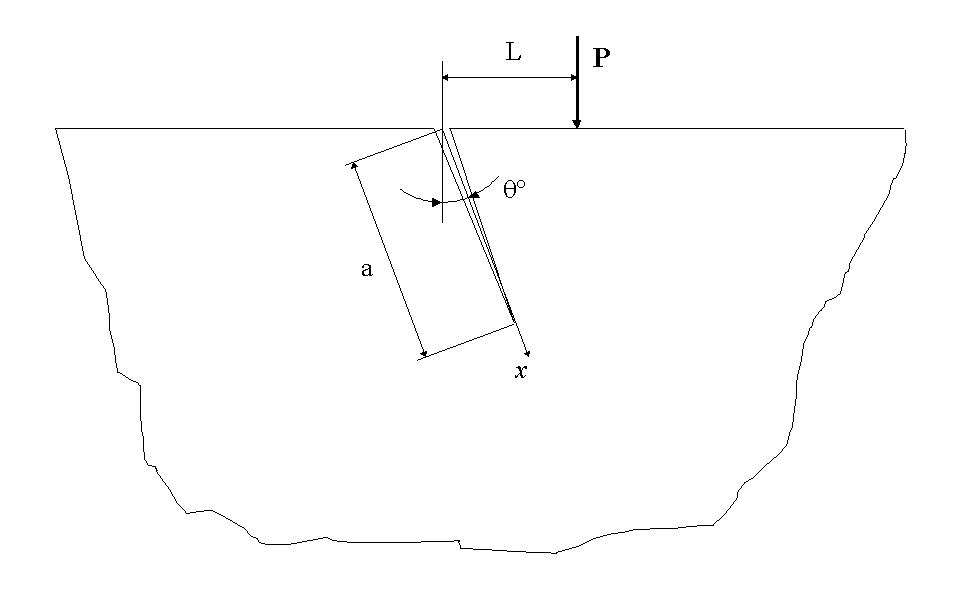
The DCMN performed a relevant amount of work in the field of WF application in Fracture Mechanics. The main activities which were conducted included:
Techniques for WF determination (an original method was proposed) |
|
Evaluation of WFs for specific cases |
|
Use of WF for Fatigue Crack Growth and Thermal Shock analyses |
|
Analysis of Crack Closure phenomena |
|
Analysis of the influence of Residual Stresses on FCG |
|
Analysis of stress distribution ahead a crack tip |
Composite Materials Damage Models
The research is oriented toward the development of models for the analysis and prediction of the onset and evolution of damage in composite laminates, subjected to static and fatigue loading.
CONTACT PEOPLE
: Prof. Marco BEGHINI, Prof. Leonardo BERTINI, Prof. Enrico MANFREDI
SELECTION OF PAPERS
| Numerical Evaluation of Two Creep-Fatigue Damage Models Under Complex Loading Histories and Multiaxial States of Stress. | Bertini L., Vitale E. | ASME Journal of Pressure Vessel Technology, Vol. 110 (1988), pp. 97-100. |
| Fatigue Crack Propagation Through Residual Stress Fields with Closure Phenomena. | Beghini, M., Bertini, L. | Engineering Fracture Mechanics, Vol. 36 (1990), n. 3, pp. 379-387. |
| Life Predictions by Three Creep-Fatigue Interaction Models: Influence of Multiaxiality and of Time-variable Loadings | Bertini, L. | Int. J. of High Temperature Technology, Butterworth Heinmann Ltd (UK), Vol. 9, n. 1, 1991, pp. 23-29. |
| Analysis of Fatigue Delamination Growth in Carboresin Specimens with Central Hole. | Beghini, M., Bertini, L., Vitale, E. | Int. J. of Composite Structures, Elsevier Applied Science Pub. Ltd (UK), Vol. 17, n. 3, 1991, pp. 257-274 |
| A Numerical Approach for Determining Weight Functions in Fracture Mechanics. | Beghini, M., Bertini, L., Vitale, E. | Int. J. for Numerical Methods in Engineering, John Wiley & Sons (UK), Vol. 32, 1991, pp. 595-607. |
| Influence of Seawater and Residual Stresses on Fatigue Crack Growth in C-Mn Steel Weld Joint. | Bertini L. | Int. J. of Theoretical and Applied Fracture Mechanics, G.C. Sih Ed., Elsevier Science Pub. B.V., Vol. 16, 1991, pp. 135-144. |
| Evaluation of Elastic Stress Distribution Ahead a Crack by Weight Functions | Beghini, M., Bertini, L., Vitale, E. | J. of Engineering Fracture Mechanics, Vol. 42, n. 2, 1992, pp. 243-250. |
| Fatigue Crack Growth Behaviour of Four Structural Steels in Air and Geothermal Fluid Environment | Bertini, L., Conti, P. | Int. J. of Fatigue, Butterworth Heinemann Ltd, Vol. 14, n.2, 1992, pp. 75-83. |
| Fatigue Crack Growth in Residual Stress Fields: Experimental Results and Modelling | Beghini, M., Bertini, L., Vitale, E. | Int. J. of Fatigue and Fracture of Engineering Materials and Structures, Vol. 17, n 12, pp. 1433-1444, 1994 |
| Hydrogen Embrittlement Characterisation by Disc Pressure Tests: Test Analysis and Application to High Chromium Martensitic Steel | Beghini, M., Benamati, G., Bertini, L. | ASME J. of Engimeering Mat. and Tech., Vol. 118, pp. 179-185, 1996. |
| Effective Stress Intensity factor and Contact Stress for a Partially Closed Griffith Crack in Bending | Beghini, M., Bertini, L. | Int. J. of Engineering Fracture Mechanics, Vol. 54, n. 5, 1996, pp. 667-678. |
| An Explicit Weight Function for Semi-elliptical Surface Cracks | Beghini, M., Bertini, L., Gentili, A. | ASME J. of Press. Vessel Technology, vol. 119, pp. 216-223 (1997) |
| Weight Functions Applied to Fatigue Crack Growth Analysis | M. Beghini, L. Bertini, E. Vitale | Special Issue of Int. J. of Fatigue and Fracture of Engineering Materials and Structures, Vol. 20, n 8, 1997, pp.1093-1104. |
| Fatigue life evaluation by weight functions for orthotropic bridge decks. | M. Beghini, L. Bertini, V. Fontanari | Int. J. of Theoretical and Applied Fracture Mechanics, vol. 28, 1997, pp. 41-50 |